
The modern workplace has changed beyond recognition. Today’s employees no longer settle for just a paycheck; they expect meaningful work, alignment with their personal values, and the opportunity to make a real difference. For HR leaders, this shift is a challenge and powerful opportunity to build a more engaged, resilient, and purpose-driven culture from the ground up.
A workplace isn't merely a feel-good initiative; it's a business imperative. Companies that successfully embed purpose into their culture see tangible benefits: higher engagement, lower turnover, and improved profitability. As the architects of workplace culture, HR leaders are uniquely positioned to drive this transformation.
The numbers tell a concerning story. According to a 2025 Gallup study, only 31% of U.S. employees report being engaged at work, a decade-low figure with serious implications for retention and productivity. This disengagement costs organizations billions of lost productivity and talent replacement.
However, the flip side is equally compelling. Companies with strong workplace purpose report 81% lower absenteeism and 41% lower turnover.
Purpose has become especially critical as younger generations enter the workforce. A Deloitte report revealed that 44% of Gen Zs and 40% of Millennials have turned down job offers due to misaligned corporate values.
Research shows that 64% of Millennials won't take a job if their employer doesn't have strong social and environmental values. With Millennials expected to account for 75% of the global workforce, purpose is no longer optional.
Purpose drives measurable business results:
A purpose-driven workplace goes beyond mission statements on walls. It's an environment where:
According to McKinsey, 70% of employees say, their sense of purpose is defined by their work. This highlights the critical role of the workplace environment in fulfilling this fundamental human need.
The pandemic accelerated a shift already underway. While 82% of US workers say it's important for a company to have a purpose, many organizations remain fixated on transactional elements like compensation and benefits.
Employees are asking not just where and how they work, but why they work. This question implies a deeper concern about work quality and the purpose that HR must address strategically.
HR professionals with strong business acumen are best positioned to connect company-level purpose with employee-level purpose. They understand how organizational values reflect the broader world and how these values motivate employees.
As organizations navigate tight labor markets and demographic shifts, HR's role becomes even more critical.
Key HR Responsibilities include:
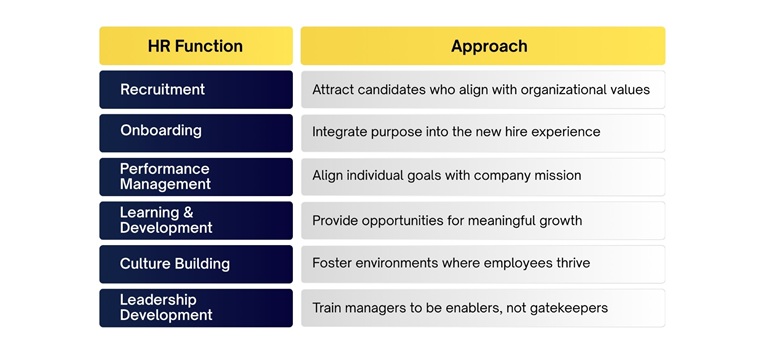
HR leaders today must move beyond compliance and perks to create environments where employees feel trusted, connected, and inspired. These proven strategies help shift culture from control to empowerment, align work with meaning, and drive engagement, retention, and innovation through purpose.
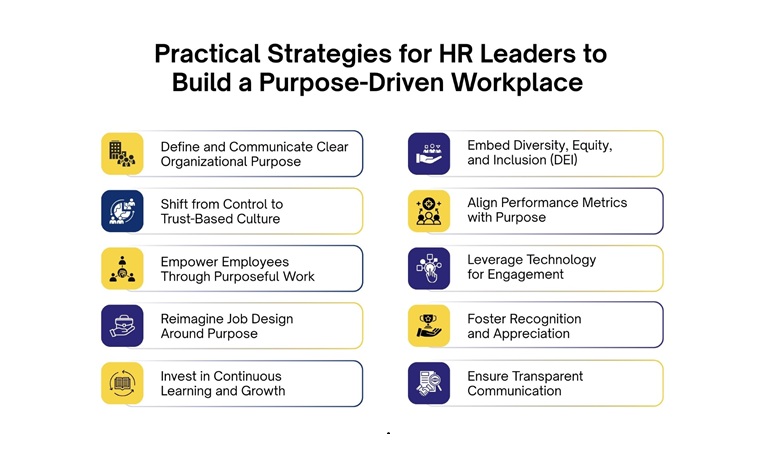
Action Steps:
Example: Salesforce's 1-1-1 model dedicates 1% of equity, product, and employee time to charitable causes, making purpose tangible and measurable.
Organizations fostering psychological safety, open feedback, and self-leadership experience higher retention and innovation. HR must:
Example: Netflix’s “Freedom and Responsibility” culture has no expense policies or fixed vacation days. Managers trust employees to act like adults, resulting in industry-leading innovation and retention.
When employees can directly contribute to something bigger than profit, engagement and pride soar. People don’t just want to work for a company that does good; they want to be part of doing it. Make that possible, and the purpose becomes personal.
Implementation Ideas:
Example: Cisco's Time2Give program offers employees five paid days annually for volunteering, strengthening loyalty while reinforcing social impact missions. The company scored a perfect 100 in the Financial Times' UK's Best Employers ranking.
Another example: Canva's "Force for Good" initiative dedicates a full week where employees volunteer, mentor, and engage in community service, boosting satisfaction while reinforcing the company's mission.
People don’t just want tasks; they want to know their work matters. When every role feels meaningful, motivation stops being something you manage, and becomes something that naturally flows from the work itself.
According to McKinsey research, when employees understand why their work matters, engagement skyrockets. HR can:
Example: Patagonia starts every job posting with its mission (“We’re in business to save our home planet”) and ties every role, from retail to finance, directly to environmental impact.
True workplace freedom means employees can reskill and grow without barriers. HR should:
Example: Amazon’s Career Choice program pre-pays 95% of tuition for in-demand fields (even if unrelated to Amazon work).
Freedom is incomplete without equity. HR must move beyond hiring quotas to:
Example: Unilever's Sustainable Living Plan integrates DEI goals with measurable progress tracking, demonstrating commitment through accountability.
If you want purpose to be more than a poster on the wall, you have to measure it and reward it.
Strategic Actions:
Example: Fortune 500 companies increasingly tie executive bonuses to sustainability and DEI outcomes, signaling that purpose matters at every organizational level.
Modern HR tech enables work at scale:
Example: Microsoft's Viva employee experience platform integrates tools, making it easier for employees to connect with mission-critical work.
Nothing brings purpose to life faster than genuine, visible recognition.
Best Practices:
Example: Cisco publicly celebrates employees' volunteer work through internal communications and awards, reinforcing the value of community contribution.
Empowered employees are the ones who know their voice matters. HR should:
Example: Cisco's weekly all-hands meetings allow employees to ask direct questions to executives, building trust and transparency.
To assess the effectiveness of initiatives, track these indicators:
Regular analysis of these metrics provides actionable insights for refining HR's approach and demonstrates ROI to leadership.
Even the best strategies face hurdles. Here’s how to tackle the biggest obstacles with practical and proven solutions.
Solution: Build a compelling, data-backed business case. Show how purpose drives retention, productivity, and revenue (e.g., companies with strong purpose outperform the market by 5–7%). Include competitor examples, industry benchmarks, and projected ROI. Present it as a strategic advantage, not just a “nice-to-have.”
Solution: Let actions speak louder than slogans. Co-create the purpose statement with employees at all levels, tie it to measurable commitments, and hold leaders publicly accountable. Authenticity grows when people see real alignment between words and decisions.
Solution: Start small and prove value. Launch low-cost pilots (peer recognition platforms, volunteer days, ERG events) and track results. Quick wins create momentum and unlock bigger budgets later. Remember that many of the highest-impact initiatives cost little more than time and attention.
Solution: Combine hard and soft data. Track quantitative indicators (e.g., engagement scores, turnover, eNPS, participation rates, with qualitative stories, testimonials, and pulse-survey comments. Present both sides to leadership: the numbers plus the human impact that numbers can’t fully capture.
When you address these hurdles head-on, purpose moves from aspiration to reality, and becomes a genuine competitive edge.
Building a workplace is an ongoing commitment that HR professionals must champion. When employees find meaning in their work, they become more engaged, motivated, and committed to organizational success.
HR teams play a crucial role in integrating purpose into organizational DNA. By empowering employees, fostering inclusivity, aligning performance with purpose, and ensuring transparent communication, HR can drive transformational change and create workplaces where employees thrive.
The numbers make it clear: companies with 21% higher profitability, 41% lower turnover, and 42% better market performance aren't achieving these results by accident. They're building cultures where purpose and performance go hand in hand.
Now is the time for HR professionals to take the lead in fostering workplaces where employees belong and contribute to something greater.