

Employee engagement stands as a cornerstone of organizational success. Engaged employees demonstrate higher productivity, stronger motivation, and deeper commitment to their work, directly impacting overall performance. Organizations seeking to enhance engagement can find powerful solutions in behavioral psychology principles. This article explores how behavioral science transforms workplaces into dynamic environments where employees thrive.
Behavioral psychology principles can shape and reinforce desired behaviors in workplace settings, ultimately driving higher engagement levels. These scientifically grounded approaches provide HR professionals with practical tools to create meaningful change.
The application of behavioral science in organizations represents a shift from simple extrinsic rewards like salary and benefits to a broader understanding that includes intrinsic motivators such as autonomy, growth opportunities, and purpose. This evolution reflects changing workplace dynamics where employees seek more than just financial compensation.
Understanding the core principles behind employee engagement is key to building a motivated workforce. This section explores foundational theories and concepts that shape how employees connect with their work and organization.

Classical conditioning involves associating new stimuli with naturally occurring stimuli to elicit desired responses. In practical terms, managers can use this principle to create positive associations with specific locations, events, tasks, or behaviors. A simple yet effective example involves encouraging employees to personalize their workspace with pictures of family, friends, and travels. This creates warmer, more positive associations with coming to work each day.
Operant conditioning focuses on using reinforcement and punishment to shape behavior. Positive reinforcement through praise, bonuses, or promotions encourages employees to repeat desired behaviors. Recognizing and rewarding employees for meeting targets motivates them to maintain high performance levels. The key lies in ensuring that reinforcement is timely, specific, and meaningful to the individual receiving it.
Edward Thorndike proposed this principle stating that behaviors followed by positive outcomes are more likely to be repeated, while those followed by negative outcomes become less frequent. Organizations can shape a culture of engagement and productivity by consistently rewarding positive behaviors and appropriately addressing negative ones. This creates a clear behavioral framework where employees understand what actions lead to positive recognition.
The evolution of employee engagement owes much to groundbreaking research and theories from the past. This section dives into the theories which have transformed how we understand and foster workplace motivation.
The Hawthorne Studies, conducted by Elton Mayo and colleagues at Western Electric during the late 1920s and early 1930s, laid the groundwork for modern understanding of employee motivation. Initially designed to examine the relationship between lighting conditions and worker productivity, these studies revealed something unexpected. Employees' productivity increased simply when they were being observed and felt valued.
This phenomenon, known as the Hawthorne effect, highlighted the significance of psychological and social factors in workplace environments. When employees felt that management cared about their wellbeing, communicated openly, and recognized their contributions, engagement naturally increased. This finding underscores the importance of interpersonal relationships, communication, and recognition in fostering engagement.
Abraham Maslow's theory provides another crucial framework for understanding employee motivation. According to this widely known model, human needs are hierarchical. Basic needs like food, water, and shelter form the foundation, followed by safety needs, social needs, esteem needs, and finally self actualization at the top.
For employee engagement, this theory suggests organizations must address basic needs first before expecting full engagement. A safe and secure work environment, opportunities for social interaction, and recognition for achievements all play key roles in meeting these needs. Once basic and psychological needs are met, employees become more likely to engage fully and perform at their best.
Frederick Herzberg distinguished between hygiene factors such as salary, job security, and work conditions, and motivators including achievement, recognition, and the nature of work itself. Herzberg demonstrated that hygiene factors prevent dissatisfaction but do not create satisfaction or engagement. Motivators, however, are key to fostering job satisfaction and engagement.
Employees who find their work meaningful, receive recognition, and have opportunities for growth and advancement feel more motivated and engaged in their roles. This theory suggests organizations should ensure adequate hygiene factors while focusing on providing meaningful, engaging work to truly inspire employees.
Putting engagement theories into action requires practical strategies tailored to today’s workplace. This section offers actionable approaches to boost employee commitment.
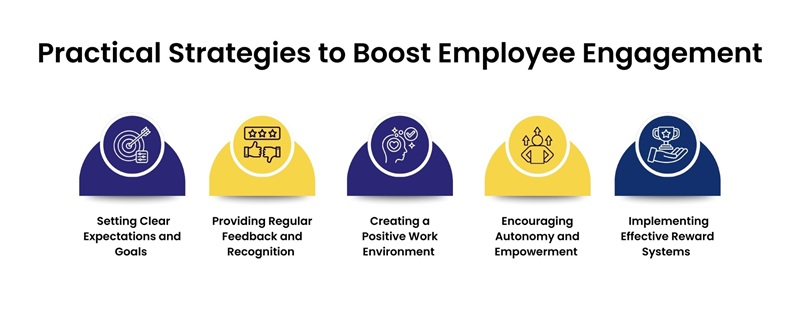
Clearly defined goals provide employees with direction and purpose. Using behavioral psychology, managers can establish specific, measurable, achievable, relevant, and time-bound (SMART) goals. Regular feedback reinforces progress and achievements, creating a continuous improvement cycle that maintains engagement over time.
Regular feedback and recognition serve as powerful tools for reinforcing positive behaviors. Behavioral psychology demonstrates that immediate and specific feedback proves most effective in shaping behavior. Recognizing employees' efforts and achievements boosts morale and engagement, creating a positive feedback loop that encourages continued excellence.
A positive work environment supporting employee wellbeing enhances engagement significantly. Behavioral psychology emphasizes environmental factors in shaping behavior. Providing a supportive and inclusive workplace, offering wellness programs that integrate with employee engagement initiatives, and promoting work life balance creates conducive conditions for engagement to flourish.
Empowering employees by granting autonomy and control over their work increases intrinsic motivation and engagement. Behavioral psychology highlights autonomy's importance in fostering ownership and responsibility. Allowing employees to make decisions and take initiative leads to higher engagement levels, as individuals feel trusted and valued.
Reward systems based on behavioral psychology principles motivate employees to perform at their best. Rewards can be tangible like bonuses and promotions, or intangible such as recognition and praise. The crucial factor is ensuring rewards are meaningful and aligned with employees' values and goals. Generic rewards often fall flat, while personalized recognition creates lasting impact.
The following real-life examples show how innovative approaches from companies like Google, Netflix, Zappos, Starbucks, and Microsoft drive employee satisfaction and organizational growth.
Google has implemented various programs supporting employee wellbeing, including free healthy meals, onsite fitness centers, and mental health resources. These initiatives have led to high employee satisfaction and engagement, demonstrating the effectiveness of prioritizing employee wellbeing. Google's use of data analytics to continuously assess and refine engagement efforts represents another key success factor.
The company's 20% time initiative, where employees can work on passion projects unrelated to core job responsibilities, encourages innovation and creativity. This drives engagement and overall satisfaction by allowing employees to pursue interests while contributing to organizational goals.
Netflix stands out for its bold approach revolving around freedom and responsibility. The company's leadership trusts employees to manage their own work and time, offering perks like unlimited vacation days and freedom to work from anywhere. This high level of autonomy encourages employees to take ownership of their roles, leading to higher engagement and innovation.
Netflix's emphasis on a results oriented work culture, rather than focusing on process and micromanagement, creates an environment where employees feel valued for their contributions. The company's transparent communication ensures that engaged employees remain aligned with organizational objectives.
Zappos is known for its commitment to creating a strong, values driven organizational culture. The company places heavy emphasis on cultural fit, ensuring employees are not just skilled but also aligned with core values. This focus on cultural alignment significantly drives engagement at Zappos.
The company's approach extends beyond monetary rewards to include creating a sense of community and shared purpose. Zappos offers opportunities for personal and professional growth through continuous learning initiatives. Its open communication policies and transparent leadership foster trust and loyalty among the workforce. The practice of holacracy, a decentralized management style, empowers employees to take ownership of their roles and make decisions autonomously, further enhancing engagement.
Starbucks emphasizes recognizing and rewarding employees for their contributions. Programs including stock options, tuition assistance, and regular recognition events foster a sense of community and appreciation among employees, leading to increased engagement. This comprehensive approach addresses both immediate recognition needs and long term career development.
Microsoft offers flexible work arrangements, allowing employees to work remotely and adjust schedules. This flexibility has resulted in higher engagement and job satisfaction, as employees can balance personal and professional lives more effectively. The company demonstrates that flexibility, when implemented thoughtfully, becomes a powerful engagement driver.
By applying behavioral psychology principles, organizations create work environments that foster genuine employee engagement. Understanding and leveraging these principles allows organizations to build motivated, productive, and engaged workforces.
As workplaces continue evolving, behavioral psychology provides the framework HR professionals need to create environments where employees thrive, organizations succeed, and innovation flourishes. The key lies in recognizing that engagement stems from understanding human behavior and applying that knowledge consistently and thoughtfully across all organizational practices.